I paint because I’m in love with my subject and I am delighted by the process of applying colour to a blank surface.
In the book Art and Fear the writers suggest that the observers who admire the finished piece of work have no interest in the artist’s process:
MAKING ART AND VIEWING ART ARE DIFFERENT AT THEIR CORE. To all reviewers but yourself, what matters is the product: the finished artwork…In fact there’s generally no good reason why others should care about most of any one artist’s work. The function of the overwhelming majority of your artwork is simply to teach you how to make the small fraction of your artwork that soars. One of the basic and difficult lessons every artist must learn is that even the failed pieces are essential.

Perhaps that is true for some, but it’s clear to me from the emails I receive and from visits to my studio from some of you, that many people are interested in other artists’ processes. Many people have a need to know how others learn and make and do. This mystery of process is seldom discussed. I like to know the back story of any person’s creation. I glean insight into that person as well as information about the made object.

In the sculptor Joe Fig’s book Inside the Painter’s Studio, New York painters talk about their studio habits and inspirations. Just as we each have a unique handwriting, so is every person unique in their approach to their work. There is no right way to approach solving a problem. Writing this blog really helps me look at my own process and helps me to stand back and look at the body of work I’m creating. Thank you for letting me share that with you.
Rural Nova Scotia is where I live. What I see throughout the day plays the most paramount role in everything I paint. Because I’ve painted almost daily for a month, The last thing I see at night when I close my eyes are images from the studio. The other night I visualized a painting I’ve been working on sporadically for two years. I started it outside at our pond in 2014 and never got back to working on it. I was fascinated by the shapes of the plant life, but that scene has changed a lot as the plants and trees grow.


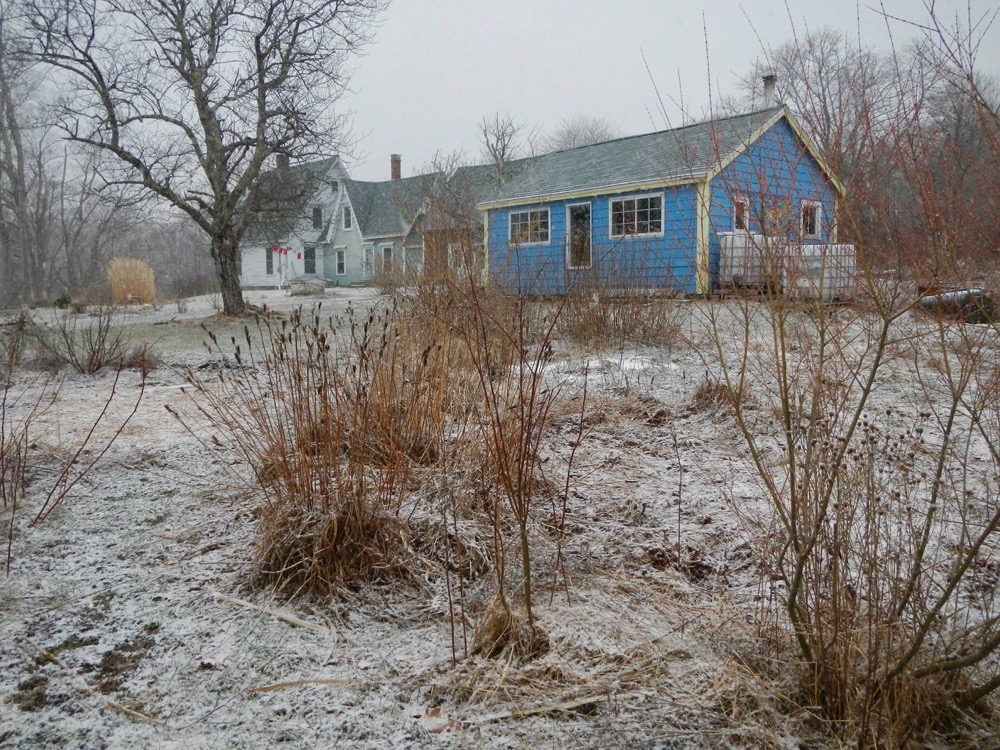
All that’s left of last summer’s plants outside are seed pods. They have a strong graphic presence against the snow and ice. So in my painting, the tangled weeds became seed pods and I cut into the images with a light ultramarine paint. This is called negative painting.
On my way to bed I watered the pea shoots that we snip and eat raw.

In bed I close my eyes and imagine painting a calligraphy line like those tendrils. I thought it would make a great contrast to the strong vertical plants.
The next morning I did just that.


This idea of painting negative shapes on the top of chaotic colors inspired me to make a background of random earth tones that I could also develop into a painting of field plants or seed pods. Although I logically shouldn’t be creating new paintings when I have many that I’m working on to finish for my April show, I have time and a studio and the inspiration.
The colors came out muddier than I wanted so I painted another one. This time I used brilliant oranges and yellows. Without planning, they echoed the same colors in a new floral painting that I’m working on.And so it goes… one action leads to another.

It’s exciting for me to see my work finally coming together. I stand back and can’t remember how I got here. It’s impossible to pick apart all the experimentation and underlying painting that each work holds.
And even if I love the result it is never as thrilling as the process.
For me and for most artists, painting is about the journey. The destination, or the finished painting signals the start of a new one.


Leave a Reply